ADA Legal Link

A barrier shut you out.
Let's figure out what to do.

If a building, a website, or a service kept you out when it was supposed to be open to you — that wasn't your fault, and it probably wasn't legal. We help you understand what happened and connect you with someone who can help.

No account required. The Standards Guide and Ada are free. Your information stays confidential.

Show Spot a photo.

A ramp, a doorway, a restroom, a parking space. Spot flags what looks like a barrier so you know what to ask about — a screening read, not a compliance check. Your first check is free. A full written report costs extra, and you see the price before you pay.

  • Take a photo
  • Upload one you have
  • Buy a full report

Tell Ada what happened.

She'll listen, help you understand whether it's an ADA issue, and — if it is — connect you to the right place. In plain language, at your pace.

Opening soon

Why she's called Ada →

What you can do here

Two ways forward

You can learn what the law says on your own, or talk it through with Ada and let her point you to the right place. Most people do a little of both.

Not sure it's even a barrier? Show Spot a photo first — it flags what looks like a problem so you know what to ask about.

Show Spot a photo →

Understand it

"Was that legal?"

Find out whether what happened is actually an ADA issue, and what the law says about it. We turned 279 pages of federal accessibility standards into plain-language guides and interactive diagrams you can search in seconds — no legal background needed.

The Standards Guide · 52 guides · 42 interactive diagrams · instant search

Explore the Standards Guide →

Act on it

"What do I do now?"

Tell Ada what happened. She'll help you validate the barrier, explain your options in plain language, and connect you where it matters — a vetted ADA attorney at no cost to you, the right complaint process, or an honest "this isn't an ADA case" if that's what it is.

Talk to Ada · validate the barrier · connect to the right place

Know your rights

The ADA protects you in three places

Which part of the law applies depends on where the barrier was. You don't have to figure this out alone — but here's the shape of it.

We handle this

Title III

Businesses & public accommodations

Any private business open to the public — its physical spaces, its website, its app. A store, restaurant, hotel, doctor’s office, or site that wasn’t accessible.

Connect through Ada — to a vetted ADA attorney, at no cost to you.

We'll point the way

Title II

State & local government

Services, programs, and facilities of state and local government — courthouses, transit, DMVs, public schools, parks, voting locations.

Often a DOJ complaint — Ada points you to the right process.

Coming soon

Title I

Employment

Hiring, firing, promotions, and accommodations at work. Routes through the EEOC and has a strict 180-day deadline — different in shape from physical and digital barriers.

Not yet built into Ada — but she can point you to the right resource.

Not sure which one applies? That's completely normal — many situations overlap. Ada asks simple questions to find the right path for you.

The ADA also includes Title IV (telecommunications relay, handled by the FCC) and Title V (anti-retaliation and other provisions). Titles I, II, and III cover the vast majority of individual claims.

What we handle right now

We'd rather tell you straight.

Better to be upfront about what Ada is built for than have you spend a hard day finding out she can't help. Right now she handles two kinds of barriers — and we're honest about the ones she doesn't, yet.

We can help with

Physical barriersA building, a doorway, a bathroom, a parking lot, a vehicle, a hotel room that wasn’t what was promised.
Digital barriersA website, an app, an online form, or a digital service that shut you out or didn’t work with the tools you use.

Not yet

Workplace & employmentADA Title I — accommodations, hiring, firing. Different in shape, routes through the EEOC. Coming.
Cognitive, communication & attitudinal barriersReal, often the worst, often the hardest to document. We’re working on the right way to handle these — and Ada may still point you to the right resource.

Why you can trust this

Built for the community it serves

These aren't marketing promises. They're the constraints we built under from the first line of code.

WCAG 2.2 AAA

The highest level of web accessibility. Keyboard navigable, screen reader tested, high-contrast and photo-sensitive-safe. You shouldn’t have to fight the site to use it.

Your privacy, protected

We gather only what’s needed to understand your barrier and connect you. Your details are never shared publicly or sold.

Vetted attorneys only

Licensed, verified, and experienced in ADA litigation. One case, one attorney — no bidding wars, no competing interests.

Clear about cost

The Standards Guide, Ada, and being connected to an attorney are free. The only paid item is a full Spot photo report, and you see the price before you pay.

Not a law firm

Ada can’t represent you. She helps you understand what happened and connects you with someone who can take the case if it calls for it.

Honest about scope

We tell you straight what we cover today and what’s coming, rather than letting you find out the hard way.

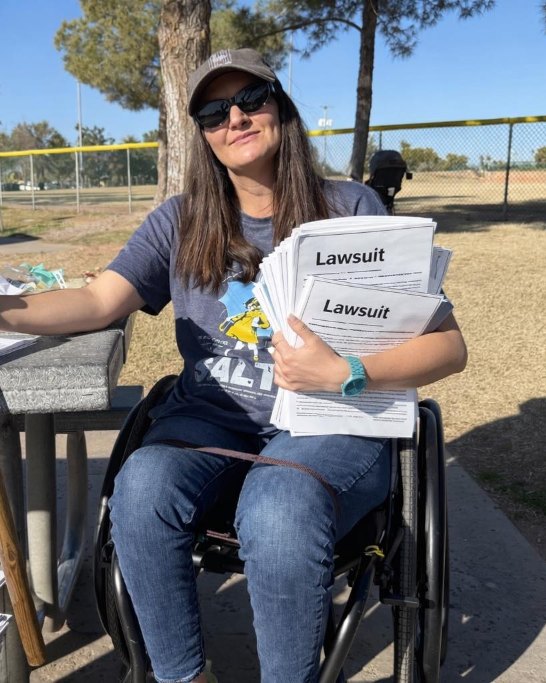
Gina Schuh outdoors at a picnic table in her wheelchair, a thick stack of lawsuit filings under one arm and a pitchfork in her other hand.

Our story

We don't want to leave anybody out.

We built ADA Legal Link because the people we love hit barriers every day that shouldn't be there. Doors too narrow. Sites that don't work with a screen reader. An "accessible" room that wasn't.

Whatever your disability, whatever the barrier — we don't want you left out. Not by the businesses you walk past every day, not by the law, and not by us.

We come at this from two sides. Gina Schuh has spent more than 20 years navigating these barriers herself — as a quadriplegic, and as a J.D. and ADA rights advocate fighting for access. She didn't just study this law; she lives it. Ryan Trout builds the platform, with accessibility designed in from the first line of code instead of bolted on after.

Gina Schuh & Ryan Trout — co-founders
The ADA was written so everyone could take part in American life.
We built this to help keep that promise.

Understand what happened, or talk it through with Ada. Whenever you're ready — there's no clock running, and it costs you nothing.

Explore the Standards Guide →

No account required. Your information is kept confidential.